
Tag Archive for: de-clutter

Where Does Clutter Come From?

Helpful Organizer BlogWhat does clutter look like to you? Is it piles of mail on the counter? Maybe it’s stacks of papers on the desk? Could it be that every drawer is a junk drawer? Perhaps it’s the layers of stuff that are hiding the dinning room table? Or maybe, it’s the garage that cars can’t fit into? Although clutter looks different for everyone, it is usually a result of two things, indecision and inaction.

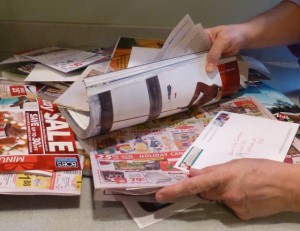
Clutter, as indecision, looks like this:  We bring the mail in on Monday, and can’t decide what to do with something. So we put it to the side to decide on later. On Tuesday, the same things happens, and then the same thing happens on Wednesday. It keeps happening until there is a mountain of mail that we don’t know what to do with.paper clutter

Clutter, as indecision, also looks like this:  We just received a new coffee maker as a gift. The old one is still good, so we put it in the basement for now, with the intention of making a decision on it later. Next thing we know, 5 years has gone by and the coffee maker is still in the basement along with a bunch of other stuff that is waiting to be decided upon.

Clutter, as inaction, looks like this:  When getting dressed in the morning the zipper breaks on the pants we want to wear. No time to deal with them now, so they get tossed on the bench at the end of the bed. At then end of the long day, we undress. To tired to deal with the dirty clothes, so they get tossed on the bench. Before we know it there is a pile of clothes on the bench.

Clutter, as inaction, also looks like this:  We bring home the groceries, but we’re having trouble fitting them into the pantry, because it is already stuffed with food. We know some of that food may be old, outdated, or expired, but we haven’t taken the time to weed it out. So the new groceries gets left out on the counter or kitchen floor.

clock for organizingNo matter what clutter looks like for you, one of the best ways to combat it is to schedule time to make decisions and take action. However, making decisions and taking action requires discipline, brain power, physical stamina, and emotional effort. That is why it’s best to devote some time daily to dealing with clutter. Instead of trying to squeeze it in, schedule time to attack it.

Another way to combat clutter is to continually weed out what we don’t want, need, or use so that it doesn’t get in the way of what is useful and important. A helpful way to do this is to have an exit strategy for the items we’re getting rid of. There are many places to donate, recycle, or re-purpose. If you need some suggestions, please ask me.


©November 2017  Janine Cavanaugh, Certified Professional Organizer®   All Rights Reserved
Storage Units – Good or Bad Solution

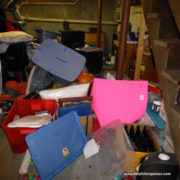
Helpful Organizer BlogWould you consider your home to be an average American home? Do you think you have just as much stuff as your neighbors? Do you rent any storage units? Would you believe that there are 300,000 items in the average American home? That’s a large number of possessions to have, store, maintain, and organize.

Where are people keeping all their stuff? Two of the most common options are in their own homes, or in a rented, off-site storage facility. Actually, the average American home has converted 3 or more spaces into make-shift storage units. (SpareFoot) On the other hand, the self storage industry is a booming business, reaching an annual revenue of 22 billion dollars in 2016. (Statistic Brain Research Institute)$22billion According to an LA Times article, there are 51,000 storage facilities in America, which is more than four times the number of McDonald’s.

Before considering another option, let’s ask the question, “Are storage units a good or bad solution?” Do they just allow us to acquire and hold onto more stuff, or do they serve a helpful role in storing our belongings ? In my opinion, I think there are two legitimate reasons for using storage units.

  • Storage units are a good idea when they help us through transitions in life. Some of those transitions may be when we’re selling a house, moving long distance, or cleaning out an estate.
  • Storage units are a good idea when they are used as temporary holding place for belongings. Some situations when a temporary holding place is needed may be when we’re dealing with a flooded basement, undergoing home renovations, or making decisions on inherited belongings.

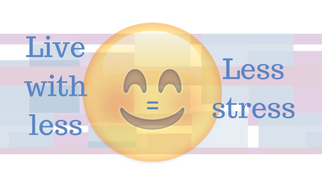
Unfortunately, most storage units start off as temporary but become long-term. So, is there another option? I think there is. Live with less stuff. It’s estimated that we use 20% of what we own, 80% of the time (Pareto Principle). That leaves plenty of room for editing and reducing. I know it can be difficult to make decisions on what to keep or not keep, so here are some helpful suggestions:Live with less = less stress


©October 2017  Janine Cavanaugh, Certified Professional Organizer  All Rights Reserved


Permission to throw away

Organizing tipGive yourself permission to throw away anything that is broken, damaged, rusty, bug-infested, mildewed, torn, stained, or incomplete. Toss these items without hesitation. You’ll get rid of clutter and free up some space.

Focus on Editing

logo2012
Busines card colors
Content
Side Notes:

I was on TV. It was only a local cable TV show, but it was still a trill. The show was the Veteran’s Forum where I shared how I help individuals get and stay organized. Want to see the half hour interview?

***  Have you ever heard of Facebook Yard Sale? It is an on-line community for selling items. You can search your local area to see if there is one in your neighborhood. You do have to have a Facebook account.

***  Question:  Do you consign anything? If so, what and where? Please share.

 logosqr.

Join Our Mailing List

Hi,

How are you enjoying your summer? Hope all is well with you. I mentioned in my last newsletter that I was excited for my big summer trip. My husband and I went on a South African Safari. It was truly amazing! The baby rhinos and giraffe were adorable. Our elephant encounter, where we touched and fed them, was the highlight of my trip. I enjoyed everything but the 15 hour flight (one way). If you’d like more detail, I’d be happy to share some of my 1600 photos. I was definitely shutter happy!

  Focus on Editing

While working with clients, much of our focus is on editing. I define editing as the process of evaluating what we have, and getting rid of stuff that no longer serves us. To assist in this process I’ve written several blog articles. Here are a few I thought you’d find helpful.
In my personal life I’ve also been focusing on editing. I donate as much as I can, but I’ve also used consignment shops for items that fit the requirements. Below are clothing and product-based consignment shops I’ve used with success.

Twice the Diva in North Attleboro, MA

Consignments on the Common (also known as Let’s Consign) in Foxboro, MA

Thrifty Witch in Bellingham, MA
Recycle Resource

Finding new ways to reuse, recycle, and reduce for myself and my clients, makes me happy. Everyone is more motivated to get rid of something when they know it is going to someone who will really use it. At New Life they do just that.

One of my class attendees told me about New Life Furniture Bank of MA, this great resource is in Walpole, MA. It is a charitable organization that accepts tax-deductible donations of furniture and household items, warehouses them, and then makes them available at no charge to those in need. You can’t get more worthy than that. Please consider New Life the next time you have something to donate.

From,

Janine Cavanaugh, CPO®
(508)-699-6652
logo square

If you’ve worked with me in any capacity, I’d be grateful for a review.  Simply click on this link and answer 3 questions.  Thank you and happy organizing!

Pocketbook Editing

Organizing tipHow often do you go through your pocketbook and get rid of all that can be tossed? Do you wait until you find yourself sifting through a crumpled mess of old receipts and candy wrappers? Do you hold off until your arm gets sore from hefting all that loose change that’s fallen to the bottom of your bag? Or, do you simply switch your wallet and cell phone to a different pocketbook when the mess gets too cumbersome to deal with?

What about the kid’s backpacks? How often do you sort through those? What about the fridge, medicine cabinet, or pantry? What about your closet, dresser, or nightstand? I’m not going to mention mail, files, coupons, recipes, or other paper. That’s a whole new topic.

Taking time to sort through and get rid of stuff helps us stay organized. By editing the contents of our pocketbooks (and all those other areas mentioned or not mentioned) we perform an important step in the organizing process, the discard and remove step. By removing what is not wanted, needed, or used, we’re able to spend less time searching for stuff. We’re also able to easily notice when something needs to be replaced, mended, or renewed.

One important factor to consider is the frequency in which we edit. If it takes a week for those receipts to become a crumpled mess, then weekly edits need to take place. If not the mess becomes very frustrating. To help reduce our stress with a disorganized, overstuffed pocketbook (or other area) timely edits are necessary. What would you consider timely? Once a week? Every other week? Once a month?

Whatever time frame you use, consistency in editing is another important factor. Creating the habit of going through your pocketbook every week (or whatever time frame you use) helps you stay organized. It also helps reduce your stress and frustration, and helps your ability to find what you want when you need it. Worthwhile benefits. Wouldn’t you agree?

©July 2017  Janine Cavanaugh, Certified Professional Organizer®  All Rights Reserved