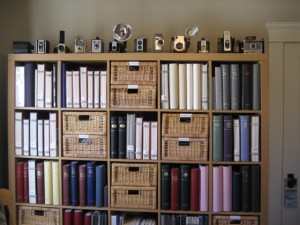
Containers are very helpful organizing tools. They come in lots of different shapes and sizes. A container can be a bin, basket, box, binder, shelf, drawer, tub, tray, rack, jar or bag. When organizing containers serve three basic purposes.
Containers help us hold like things.
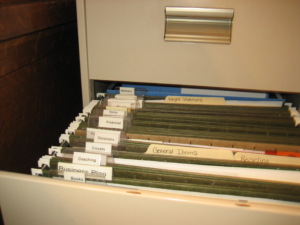 How many junk drawers do you have, and what’s inside them? Junk drawers are usually stuffed with a jumbled mess of random things, hence the name. Therefore, my recommendation is two small junk drawers per household, but that’s it. The rest of our drawers, and all the other containers in our home, need to be filled with items that belong together. For example, store all your tools in a tool box. Hold all your mending things in a sewing basket. Corral all your books on a bookcase. Put all your files in a file cabinet. It’s easier to find things that way and easier to remember where they are. Items that belong together need to be stored together. Other examples of ready-made containers are tie rack, jewelry box, magazine rack, hamper, fishing tackle box, golf bag, shoe rack, toy box, knitting bag, and pot rack. I can list a bunch more, but I think you get the idea.
Containers help us create storage boundaries.
 Containers create boundaries where there are none. They help us corral small items such as makeup, jewelry, crafts, snacks, and toiletries. Containers help divide drawers into sections. Which is great for organizing our junk drawers, by the way. Some examples are expandable cutlery trays, utensil trays, jewelry organizers, craft bead bins, and sock organizers. Another way to create storage boundaries where we don’t have any is to use tape, paint or permanent marker. Create pie sections on our lazy Susan’s and label them as granola bars, cereal, oatmeal, etc. Create parking spaces for bikes in the garage by taping off sections and putting names on them. Tape off labeled sections on the floor of a coat closet for shoes and boots. Use the container to help create and maintain storage boundaries.
Containers provide storage guidelines.
 The container helps us see when we have enough. They give us a visual indication of when we have reached the container’s maximum capacity. Therefore reducing our chances of over-stuffing. However it’s important to stay within the limits of the container. If we allow items to spill out and create piles of stuff outside the container, we’re not following the storage guidelines. Once this happens we’re tempted to purchase another container and not use our existing container as a guide, but it’s much easier to maintain order when we don’t over-stuff. Practice the one-in-one-out rule when faced with the need to stay within the container limits.
©April 2021 Janine Cavanaugh, CPO All Rights Reserved

 In order to reduce clutter, we need to get rid of more than we bring in. Think like a mathematician, the rate at which we bring things in needs to be less than the rate at which we remove things.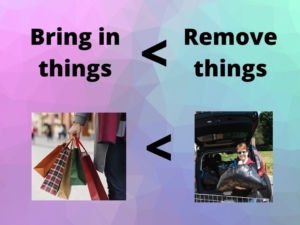


 Janine Cavanaugh, CPO

Follow Me