Two Most Common Organizing Issues
One of the most common issues people face when organizing and downsizing is deciding what to keep. Here is a tool that is helpful during the decision making process. This tool is from the book, Organizing for Dummies by Eileen Roth and Elizabeth Miles.
When deciding to save or not use the acronym WASTE.
- W = worthwhile
- A = again
- S = somewhere else
- T = toss
- E = entire
This acronym is a great tool because it prompts us to ask questions regarding the usefulness of the items on which we’re deciding. We need to be honest with our answers and with our assessment of the items in question.
- Why is this item worthwhile to keep?
- When will we use it again within the next year?
- Can we find it easily somewhere else, if we need to?
- What will happen if we toss it?
- Do we need the entire thing? If not, keep what we need and toss the rest.
A second common issue people face when organizing and downsizing is deciding what to do with the items that aren’t being kept. The options are countless, but what I have witnessed over the years is that it’s helpful to find a donation destination that motivates us to let go of stuff. Let me share some of the most common ones that I use for myself and for my clients.
- Give to someone we know, friends, family, neighbors
- Always ask! Don’t assume people want things that you want to pass along to them.
- Donate to a non-profit organization that will give directly to those in need
- Clothes To Go, North Attleboro, MA 401-651-3936
- Docas International, Providence, RI 401-784-8600
- New Life Furniture Bank of MA, Walpole, MA 774-316-6395
- Donate to a resale organization
- Savers, North Attleboro, MA 508-695-1068
- Saint Vincent dePaul, Plainville, MA 508-695-5150
- The Goodwill Store, South Attleboro, MA 508-399-7601
- Offer up for free
- Freecycle
- Buy Nothing
- Put on curb with free sign attached
- Sell the items yourself
- Consign the items
- PoshMark.com
- ThreadUp.com
- Blackbirds Consignment Shop, Providence, RI 401-353-2028
©November 2021 Janine Cavanaugh, CPO All rights reserved


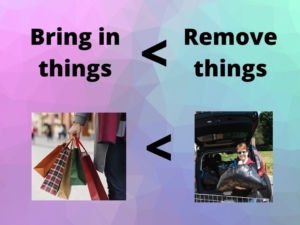
In order to reduce clutter, we need to get rid of more than we bring in. Think like a mathematician, the rate at which we bring things in needs to be less than the rate at which we remove things.


Janine Cavanaugh, CPO
How many junk drawers do you have, and what’s inside them? Junk drawers are usually stuffed with a jumbled mess of random things, hence the name. Therefore, my recommendation is two small junk drawers per household, but that’s it. The rest of our drawers, and all the other containers in our home, need to be filled with items that belong together. For example, store all your tools in a tool box. Hold all your mending things in a sewing basket. Corral all your books on a bookcase. Put all your files in a file cabinet. It’s easier to find things that way and easier to remember where they are. Items that belong together need to be stored together. Other examples of ready-made containers are tie rack, jewelry box, magazine rack, hamper, fishing tackle box, golf bag, shoe rack, toy box, knitting bag, and pot rack. I can list a bunch more, but I think you get the idea.
Containers create boundaries where there are none. They help us corral small items such as makeup, jewelry, crafts, snacks, and toiletries. Containers help divide drawers into sections. Which is great for
The container helps us see when we have enough. They give us a visual indication of when we have reached the container’s maximum capacity. Therefore reducing our chances of over-stuffing. However it’s important to stay within the limits of the container. If we allow items to spill out and create piles of stuff outside the container, we’re not following the storage guidelines. Once this happens we’re tempted to purchase another container and not use our existing container as a guide, but it’s much easier to maintain order when we don’t over-stuff. Practice the 

Follow Me